
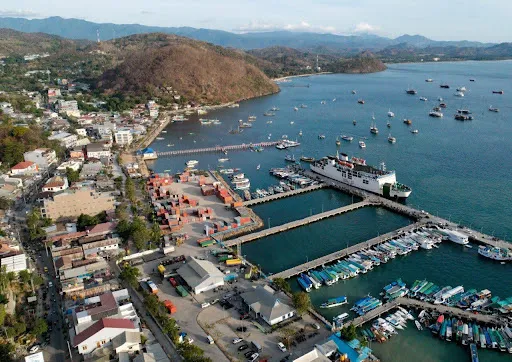
Container shipping is the cheapest way per piece to import Buddha statues from Bali in volume, because a single sea-freight container cost is shared across every statue inside it. A 20-foot container can hold roughly a few dozen medium hand-carved statues depending on their size and crating, and a 40-foot container roughly double that. The more you fill it, the lower the freight cost carried by each individual piece — which is why serious wholesale buyers, retailers and hospitality groups ship by the container rather than piece by piece. Total cost depends on container size, the origin port (Bali/Surabaya), your destination port, and current freight rates.
This guide is written by our workshop desk, which handles commissions, crating and export. We consolidate and ship container-scale orders of hand-carved stone and bronze statues worldwide. This guide explains container shipping clearly so you can plan volume, cost and timeline before you order. When you are ready to price a container, our wholesale supplier page has the trade details, or request a quote directly.
Why container shipping wins on price
The logic is simple but decisive. International sea freight is priced mainly by the container, not by the individual item inside it. So:
- Ship one statue, and it must carry essentially all of the shipping cost — freight can rival or exceed the price of the statue itself.
- Ship forty statues in one container, and that same container cost divides across forty pieces — the freight component of each statue drops dramatically.
This “shared freight” effect is the entire economic reason wholesale buyers order in bulk. It is the same principle we explain in our wholesale pricing guide — but container shipping is where the biggest slice of the saving actually comes from. If you are only buying one or two pieces, container shipping is not for you; you will use courier or consolidated LCL freight, covered in our single-statue shipping cost guide.
FCL vs LCL — which do you need?
There are two ways to use a container.
FCL (Full Container Load). You book an entire container exclusively for your goods — a 20ft or 40ft box. This gives the lowest freight-per-piece if you can fill it, plus the security that only your statues are inside, reducing handling and mix-ups. This is the route for buyers ordering enough to fill (or nearly fill) a container.
LCL (Less than Container Load). Your statues share a container with other exporters’ goods, and you pay for the space (volume) you use. This suits medium orders too small to justify a full container but too large for courier. LCL is more cost-efficient than air or courier per piece, though not as cheap as a well-filled FCL, and it involves consolidation and deconsolidation steps that add a little time.
We can advise which makes sense for your order size and even help you fill a container efficiently by mixing statue sizes and models.
How many statues fit in a container?
This is the question every trade buyer asks, and the honest answer is “it depends on size and crating,” but here is a practical way to think about it. Statues are crated individually or in grouped timber crates, and it is the crated volume and weight that fills the container, not the bare statue. Stone is dense, so on heavy stone orders you often hit the container’s weight limit before you run out of floor space — an important planning point most first-time buyers miss.
As a rough planning guide:
- A 20ft container typically carries in the region of a few dozen medium (roughly 60 cm–1 m) crated stone statues, or fewer if they are large.
- A 40ft container carries roughly double the floor volume, but the weight limit still governs heavy all-stone loads.
For an accurate count we work backwards from your actual model-and-size mix. Tell us what you want to stock and we will tell you exactly how it packs and how many containers it needs.
What drives your container shipping cost
Five variables set the number:
- Container size — 20ft vs 40ft.
- FCL vs LCL — full booking vs shared space.
- Route — origin port (Bali’s Benoa or, more commonly for volume, Surabaya/Tanjung Perak) to your destination port. Longer, less-served routes cost more.
- Current freight rates — ocean freight prices move with global demand, fuel, and season; a rate valid this quarter may shift next quarter, so always price close to shipping.
- Destination charges — port handling, customs clearance, duties/taxes, and inland delivery at your end. Freight to the port is only part of landed cost.
Because rates fluctuate, we quote container freight fresh at the time of order rather than publishing a fixed figure that would mislead you.
Timelines by region
Ocean freight is slower than air but incomparably cheaper per piece for volume. Add the carving time first — a container-scale order of hand-carved statues takes several weeks to produce — then the sea transit. Rough sea-transit planning figures from Indonesia:
- Australia — the fastest major market, a couple of weeks or so at sea.
- Asia and the Middle East — a few weeks.
- Europe and the US East Coast — often around a month to six weeks at sea.
- US West Coast — typically faster than the East Coast.
Then allow additional time at the destination for customs clearance and inland delivery. Our region-by-region shipping timelines guide breaks this down further. The headline: plan a container order a couple of months ahead of when you need the stock on the ground, and more for seasonal ranges.
Getting your statues container-ready
Every statue in a container must be crated to survive weeks of sea motion and stacking. Proper immobilised crating on ISPM-15 heat-treated timber is non-negotiable — loose packing is what cracks statues in transit, and non-compliant wood can be held at customs. We build crates to each statue’s shape and comply with international timber rules on every shipment; the full method is in our guide to packing and crating a stone statue for export. For the legal side of exporting in volume, see is it legal to export Buddha statues from Bali.
Global containerised trade runs on standardised sea freight and documentation overseen by bodies such as the International Maritime Organization (imo.org); working with an exporter who knows this system end to end is what keeps a container order predictable rather than stressful.
Ship a container with us
At Suryana Buddha Atelier we produce, consolidate, crate, and ship container-scale statue orders factory-direct from Batubulan — FCL or LCL, with transparent freight quoted at order time and clean export paperwork. See the trade offer on our wholesale supplier page, read our workshop story on the Suryana Buddha Atelier homepage, and when you are ready, send your order mix.
Planning a bulk import? Message the atelier on WhatsApp at wa.me/6281139414563 or request a container quote through our contact page. Give us your models, sizes, quantities and destination port — we will tell you how it packs, how many containers you need, the current freight, and the landed cost per statue.