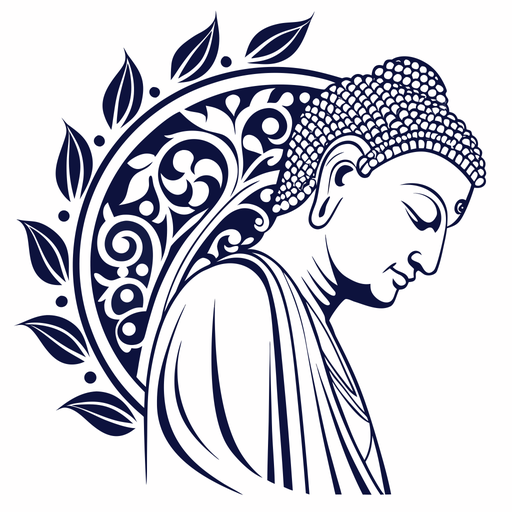
The meaning of Buddha statue poses is written almost entirely in two
places: the position of the body (the asana) and the position
of the hands (the mudra). A seated Buddha with the right hand
draped over the knee, fingertips pointing to the ground, is the
earth-touching Buddha — the moment of enlightenment. A standing Buddha
with the palm raised outward is offering fearlessness and protection. A
reclining Buddha lying on its right side is entering
parinirvana, the final peace. Once you can read these signals,
choosing a statue stops being about “which one looks nice” and becomes
about which meaning you want to live with every day.
Our workshop desk wrote this guide, and it approves what leaves the yard. This guide is the same explanation we give buyers who visit the atelier before they commission a piece. If you already know you want a specific pose carved to your dimensions, you can skip ahead and request a quote on our contact page, or browse finished examples in our Buddha Statue Collection.
Why the pose matters
more than the size
Most first-time buyers start with size — “I need something about a
metre tall for the garden.” That is a practical question, and it matters
for shipping and placement. But the pose is what gives the statue its
presence. A metre-tall meditating Buddha brings a completely different
feeling to a courtyard than a metre-tall teaching Buddha. One invites
stillness; the other invites attention. In Balinese carving tradition,
we treat the pose as the soul of the piece and the stone as its
body. When I approve a commission, the first thing I confirm with the
client is never the height — it is the mudra.
The word mudra simply means “gesture” or “seal” in
Sanskrit. Each hand position is a fixed symbolic code that has been
consistent across Buddhist art for roughly two thousand years, from the
earliest Gandhara sculptures to the pieces we carve today. The
asana is the seated or standing posture that frames the
mudra. Together they tell you exactly which episode from the Buddha’s
life, or which spiritual quality, the statue represents.
The six poses you
will actually encounter
Buddhist iconography catalogues dozens of mudras, but in practice —
especially for garden, home, hotel and spa decor — six account for the
overwhelming majority of what people want. Here is what each one means
and where it belongs.
1. The Meditating Buddha
(Dhyana Mudra)
Both hands rest in the lap, right hand on top of the left, palms
facing upward, thumbs lightly touching to form a triangle. The legs are
folded in full lotus. This is Dhyana mudra, the gesture of
meditation and the concentration of the mind.
This is the most requested pose in our workshop, and for good reason.
It is calm, symmetrical, and self-contained. It suits a balinese
meditating buddha statue for garden placement, a yoga studio, a
spa reception, or a quiet reading corner. Because the silhouette is
compact and stable, it also carves beautifully in both paras stone and
black lava, and it ships well because there are no vulnerable
outstretched limbs. If you want a single statue to anchor a peaceful
space, this is the one I recommend first.
2. The
Earth-Touching Buddha (Bhumisparsha Mudra)
The Buddha sits in lotus, left hand open in the lap, and the right
hand reaches down over the right knee so the fingertips touch the
ground. This is Bhumisparsha mudra — “touching the earth.” It
depicts the exact instant of enlightenment beneath the Bodhi tree, when
Siddhartha called the earth itself to witness his awakening.
This pose carries the most narrative weight of any seated Buddha.
Collectors and people building a genuine meditation practice often
choose it deliberately because it represents the triumph over doubt and
temptation. Visually it is slightly asymmetric, which gives it more
movement than the pure meditation pose. It is a superb centrepiece for a
zen garden or a hotel lobby where you want a statue
that rewards a second look.
3. The Teaching Buddha
(Dharmachakra Mudra)
Both hands are held at chest height, thumbs and index fingers
touching to form circles, symbolising the turning of the wheel of
Dharma — the Buddha’s first sermon at Sarnath. This is
Dharmachakra mudra, the gesture of teaching.
I recommend this pose for schools, wellness centres, libraries, and
any space dedicated to learning or dialogue. It is a more intricate
carve because of the fingers held in mid-air, so it takes an experienced
hand and slightly thicker stone at the wrists for outdoor durability.
When clients want something with intellectual rather than purely
contemplative energy, this is the answer.
4. The Protection Buddha
(Abhaya Mudra)
Usually shown standing, the right hand is raised to shoulder height,
palm facing outward, fingers pointing up. This is Abhaya mudra
— “no fear.” It is a gesture of protection, peace, and reassurance, said
to represent the Buddha calming an angry elephant sent to harm him.
A standing protection Buddha works wonderfully at an entrance — a
driveway, a gate, a hotel doorway — because it faces and greets whoever
arrives. It is the classic “welcome and shelter” statue. When it is
paired with the left hand facing outward and downward, the second
gesture is Varada mudra, the giving of compassion and granting
of wishes, so many standing Buddhas carry both meanings at once.
5. The Reclining Buddha
(Parinirvana)
The Buddha lies on his right side, head resting on the right hand,
legs extended. This is the parinirvana — the Buddha’s physical
death and passage into final nirvana, free from the cycle of
rebirth. It is not a sad image; in Buddhist thought it is the ultimate
release and peace.
Reclining Buddhas are horizontal, which makes them dramatic anchors
for long garden beds, poolside ledges, and wide spa platforms. Because
of their length they need careful planning for weight distribution,
plinth support, and crating — something we handle as part of any
commission. A balinese reclining buddha statue in stone
is one of the most striking pieces you can own, but it is also the one I
most strongly advise buying hand-carved rather than moulded, because the
flowing robe folds are where a master carver’s skill truly shows.
6. The Buddha Head
Strictly speaking a Buddha head is not a mudra at all, but it
deserves a place here because it is one of the most popular decor pieces
we make. A balinese buddha head statue in stone focuses
entirely on the serene facial expression, the elongated earlobes (a sign
of the renounced princely life), and the ushnisha — the cranial
bump symbolising wisdom. Heads suit modern, minimalist interiors and
courtyards where a full-body statue would be too literal. They are also
lighter and cheaper to ship.
How to choose the
right pose for your space
Here is the shortcut I give clients. Match the feeling you want
the space to have to the pose:
- Stillness, focus, meditation → Meditating Buddha
(Dhyana) - Strength, breakthrough, a meaningful centrepiece →
Earth-Touching Buddha (Bhumisparsha) - Learning, conversation, growth → Teaching Buddha
(Dharmachakra) - Welcome, safety, an entrance greeting → Standing
Protection Buddha (Abhaya) - Release, deep rest, a long horizontal feature →
Reclining Buddha (Parinirvana) - Modern minimalism, a lighter accent → Buddha
Head
There is no wrong choice in a religious or cultural sense — every
authentic pose is respectful when displayed thoughtfully. If you would
like to read more about where to physically position your
chosen statue for the best energy flow, our companion guide on feng shui Buddha statue
placement walks through room-by-room and garden placement in
detail.
A note on authenticity and
craft
The Metropolitan Museum of Art’s timeline of Buddhist sculpture notes
that these gestures were codified early and have remained remarkably
stable across two millennia of Buddhist art (see the Met’s “Buddhism and
Buddhist Art” resource on metmuseum.org). That consistency is exactly
why a genuinely hand-carved statue matters: a skilled carver knows the
correct proportions and gestures, while a cheap moulded copy
often gets the fingers, the lotus, or the robe folds subtly wrong. When
the mudra is carved incorrectly, the meaning is broken.
At Suryana Buddha Atelier every statue is carved by hand from
Balinese stone — paras limestone-tuff from Kerobokan or black volcanic
lava from Karangasem — following the traditional iconography my family
has kept for three generations. If you want to understand how to spot a
real hand-carved piece from a moulded import, we have a full guide on how to tell
if a Balinese Buddha statue is authentic.
Ready to choose your Buddha?
Once you know the pose, the rest is straightforward: material, size,
finish, and shipping. You can explore finished pieces on our Buddha Statue Collection pillar,
read the full story of our Batubulan workshop on the Suryana
Buddha Atelier homepage, and when you are ready to buy or commission
a specific pose in a specific size, send us the details.
Talk to a carver directly. Message Wayan and the
atelier team on WhatsApp at wa.me/6281128590000 or request a quote through our contact page. Tell us
the pose, the material, and where the statue will live — we will carve
it to suit, crate it, and ship it worldwide.